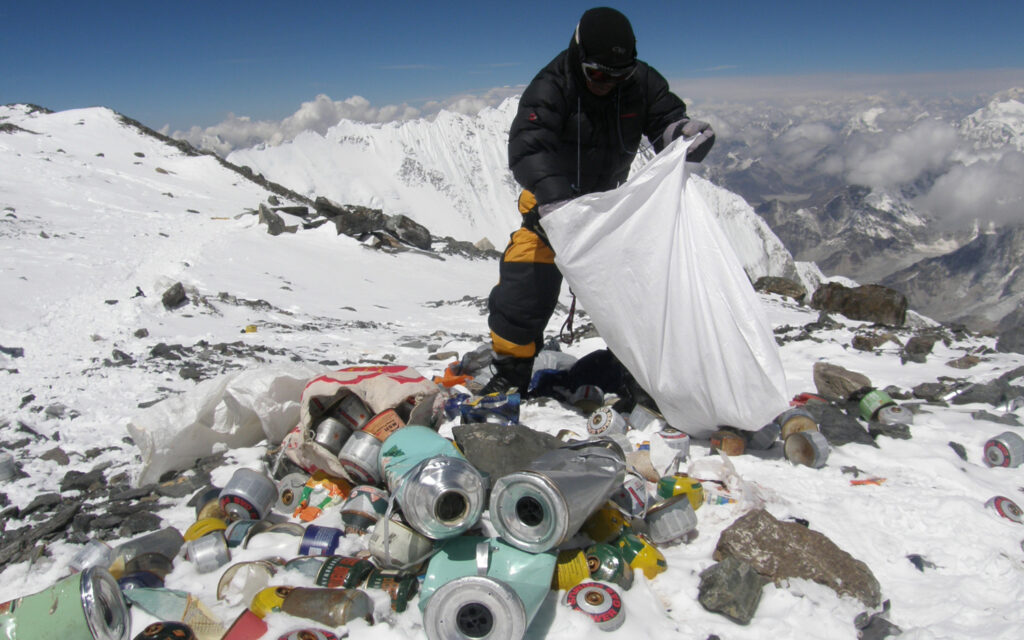
Mount Everest must be put on a world heritage danger list, say campaigners, or both the environment and local residents will be put at risk.
Lawyers, environmental campaigners and record-breaking Nepalese climbers this week hand-delivered a petition to the United Nations’ World Heritage Committee, demanding that the legal duty to protect the Sagarmatha National Park and area surrounding Mount Everest is respected.
The melting of ice, caused by climate change, could swell Himalayan rivers to bursting point unless urgent action is taken, threatening the lives of thousands of people and destroying a unique and irreplaceable environment.
Although specialists agree that many lakes are at risk, Friends of the Earth (FoE) claims that they are not monitored adequately, providing no realistic assessment of just how close to bursting they really are.
By adding the national park surrounding Everest to the danger list would mean that UNESCO, the UN organisation for education, science and culture, would have to assess Nepal’s glacial lakes and stabilise those that were most at risk.
Prakash Sharma, the director of Pro Public, Nepal’s branch of FoE, said that Mount Everest was a powerful symbol of the natural world far beyond Nepal, and urgently needed to be protected.
“If this mountain is threatened by climate change, then we know the situation is deadly serious,” he warned. “If we fail to act, we are failing future generations and denying them the chance to enjoy the beauty of mother earth.”
As well as non-government organisations such as FoE, those supporting the petition include mountaineers and adventurers Sir Chris Bonington, Reinhold Messner, Stephen Venables, and conservationist and broadcaster Sir David Attenborough.
Sir Chris Bonington pointed out that Sagarmatha National Park not only had the highest mountain and some of the finest mountain scenery in the world, but it was home to the Sherpas, its inhabitants, who now lived and worked there in fear of the lakes bursting.
“Both the beauty of this magnificent area and the livelihoods of its inhabitants are threatened by global warming,” he said.
Publisher: www.edie.net/
Writer: Jane Kettle
Link: https://www.edie.net/unesco-must-protect-everest-or-face-consequences/